
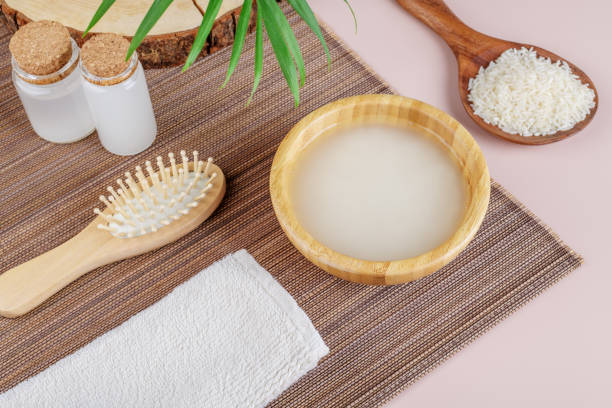
Rice water has become one of those beauty remedies that seems to be everywhere.
You may have seen videos of people soaking rice, saving the cloudy water, and pouring it over their hair. Some swear it makes their strands shinier. Others say it reduces breakage, improves softness, or helps their hair grow longer.
And then there’s the big claim: rice water can make your hair grow faster.
Sounds tempting, especially when you’re juggling work, school, family, errands and approximately 47 other things before lunchtime.
But is rice water actually effective for hair, or is it another internet beauty trend that sounds better than it works?
Here’s the honest answer: rice water may help hair feel smoother and reduce some types of breakage, but there isn’t strong scientific evidence that plain rice water makes hair grow faster. Dermatologists also point out that much of the excitement around it comes from anecdotal reports rather than clinical research.
That doesn’t mean you need to throw your rice water away.
It simply means we need to separate the reasonable benefits from the bigger promises.
First, what exactly is rice water?
Rice water is pretty much what it sounds like: water that has been used to soak or cook rice.
As rice sits in water, some starch and other compounds move into the liquid. The result is usually cloudy, milky-looking water that can be applied to the hair as a rinse.
There are several ways people prepare it. Some soak uncooked rice in water for a short period. Others boil rice and save the cooking water. Another popular method involves fermenting the mixture for a day or longer.
Social media has given this simple kitchen ingredient a glamorous makeover, but the tradition itself is much older.
Rice water has been used in Asian hair-care traditions for centuries. Stories from Japan and China are often connected to the modern popularity of the practice. Today, though, TikTok and Instagram have pushed it into mainstream beauty culture, where it’s often presented as a cheap answer to everything from dull hair to hair loss.
That’s where things get a little murky.
Traditional use can be meaningful, but tradition alone doesn’t prove that a treatment will stimulate new hair growth.
And that distinction matters.
So, is rice water effective for hair?
Possibly, but probably not in the way social media suggests.
The strongest argument for rice water is not that it magically creates new hair follicles. Rather, it may improve the way existing hair feels and behaves.
Rice water contains starch. According to dermatologists interviewed by Cleveland Clinic, that starch may coat the outer surface of the hair shaft and reduce friction between strands. Less friction can mean less fraying and breakage.
Think of it like smoothing the surface of a rough piece of fabric.
You’re not creating more fabric. You’re simply making the existing fibres less likely to rub against one another.
That can matter if your main problem is breakage.
Imagine you’ve been trying to grow your hair for months, but the ends keep snapping. Your scalp may actually be producing hair at a normal rate. The issue is that the lengths aren’t retaining it.
That’s a very different problem from slow hair growth.
And it’s one reason someone might use rice water and honestly feel that their hair is “growing faster.”
Maybe it isn’t growing faster.
Maybe it’s breaking less.
That’s an important difference.
Rice water and hair growth: here’s where the evidence gets thin
Let’s address the claim that attracts the most attention.
Can rice water make your hair grow faster?
There isn’t good clinical evidence showing that ordinary homemade rice water significantly speeds up hair growth.
Cleveland Clinic notes that although rice water contains compounds such as inositol that have been associated with hair health, the supposed hair-growth effects of rice water itself have not been scientifically proven.
Hair growth is influenced by much bigger factors, including genetics, age, nutrition, hormones and overall health.
Your hair follicles have their own growth cycles. A rinse you apply to the hair shaft doesn’t suddenly rewrite that biological schedule.
That’s why the phrase “hair growth” can be misleading.
There are really two separate goals:
- Growing new hair from the scalp
- Keeping the hair you already have from breaking
Rice water may have more relevance to the second goal than the first.
And honestly, that’s still useful.
For someone trying to grow longer hair, length retention is a huge part of the equation.
What about the inositol in rice?
You’ll often hear about inositol when people explain why rice water supposedly works.
Inositol is a naturally occurring compound found in rice and other foods. Rice contains several nutrients and compounds that have attracted interest in hair and skin research.
But here’s the catch: finding a potentially useful compound in rice does not automatically prove that applying homemade rice water to your scalp will produce a noticeable hair-growth effect.
That leap happens often online.
A → B → therefore miracle.
Real biology is usually less tidy.
Cleveland Clinic notes that inositol has been promoted as a hair-growth ingredient, but dermatologists still emphasise that there isn’t enough scientific evidence to establish rice water as a proven hair-growth treatment.
So if you’re using rice water, think of it as a possible hair-care rinse, not a proven treatment for hair loss.
That distinction will save you a lot of frustration.
What benefits might rice water actually offer?
While the evidence for hair growth is limited, rice water may still have a place in a simple hair-care routine.
1. It may make hair feel smoother
The starch in rice water can coat the hair surface.
That coating may temporarily make strands feel smoother and easier to manage. If your hair tends to feel rough after washing, you may notice a difference.
This is especially appealing when you’re rushing to class, heading into a morning meeting, or trying to get the kids out the door while your own hair is somehow the last thing on your list.
A simple rinse can feel wonderfully low-maintenance.
2. It may help reduce breakage
Hair breakage is one of the biggest reasons people feel like their hair “isn’t growing.”
The American Academy of Dermatology explains that damaged hair is fragile and more likely to break. Hair-care habits such as excessive brushing, rough handling and certain styling practices can contribute to damage.
Because rice starch may reduce friction along the hair surface, rice water could potentially help with this part of the equation.
Again, that doesn’t mean it repairs severely damaged hair.
Hair that has already split or broken can’t be magically reconstructed with a kitchen rinse. But reducing additional friction may help you handle the hair more gently.
3. It may improve shine
Some people report that rice water makes their hair look shinier.
That could be related to the temporary coating left by starch. When the surface of the hair is smoother, light may reflect more evenly.
The result can be hair that looks polished rather than rough or dull.
But don’t confuse temporary shine with improved biological health.
A shiny strand isn’t necessarily a stronger strand.
4. It may make detangling easier
If a rinse leaves your hair feeling smoother, you may find that combing becomes easier.
That’s useful because aggressive detangling can cause mechanical damage.
The American Academy of Dermatology recommends minimising unnecessary brushing and handling wet hair carefully because wet hair is more prone to breakage. For tightly curled or textured hair, however, the AAD notes that brushing while wet can reduce breakage compared with brushing when dry.
So the goal isn’t simply “never brush wet hair.”
The goal is less unnecessary pulling and friction.
That’s a much more practical rule.
Rice water isn’t the same as rice bran extract
This is one of the most important details to understand if you’ve been reading scientific studies about rice and hair.
Research exists on rice bran extracts, but that doesn’t mean the same evidence applies to homemade rice water.
A 2022 systematic review examined studies involving rice bran products and hair growth. The researchers found promising biological effects, including changes in pathways associated with the hair-growth phase. However, they also noted gaps in the clinical evidence.
There has also been a small randomised controlled trial involving a specific rice bran supercritical CO₂ extract in people with androgenic alopecia. The study reported improvements in hair density and diameter after 16 weeks.
That sounds exciting.
But there’s an important catch.
A specialised rice bran extract used in a controlled study is not the same thing as water left over from your dinner preparation.
Different ingredients. Different concentration. Different preparation. Different study conditions.
So you shouldn’t look at a rice bran study and conclude, “Great, my homemade rice water is clinically proven for hair loss.”
It isn’t.
The research is interesting, but the leap is too big.
How to make rice water for your hair
If you want to try rice water, the simplest approach is also the one dermatologists may find easiest to manage.
Cleveland Clinic describes several preparation methods, including soaking, boiling and fermentation. Its dermatology guidance favours a shorter soaking method over lengthy fermentation because prolonged soaking can introduce bacteria into the mixture.
Simple rice water recipe
You’ll need:
- ½ cup uncooked rice
- About 2 cups of clean water
- A clean bowl or jar
- A strainer
Step 1: Rinse the rice
Give the rice a quick rinse to remove surface dirt and excess residue.
Step 2: Soak it
Place the rice in clean water and let it sit for around 30 minutes to two hours.
There’s no need to turn this into an overnight science experiment.
Step 3: Strain it
Separate the rice from the water.
You can cook the rice afterwards rather than wasting it. Cleveland Clinic notes that the rice remains edible after making rice water.
Step 4: Apply the water
Wash your hair as usual.
Then apply the rice water to your hair, making sure the lengths are coated.
Step 5: Leave it briefly
Cleveland Clinic cites dermatology guidance recommending about 20 minutes before rinsing the rice water out.
Step 6: Rinse thoroughly
This part matters.
Don’t assume that leaving residue behind will make the treatment more powerful.
More isn’t always more.
If your hair or scalp feels coated, sticky or uncomfortable afterwards, rinse more thoroughly or stop using it.
Should you ferment rice water?
Fermented rice water has become particularly popular online.
Some beauty routines suggest letting rice water sit for a day or more before using it.
The theory is that fermentation changes the mixture and may make it more beneficial.
The problem is that long fermentation also creates a food-safety and hygiene issue.
Cleveland Clinic specifically cautions that longer soaking can allow bacteria to grow.
For a busy professional or parent, there’s also a simpler question:
Why make the process harder than it needs to be?
A short soak is easy. It doesn’t require planning your hair routine around a jar sitting on the counter for two days.
Sometimes simple really is better.
How often should you use rice water?
There isn’t a scientifically established schedule for homemade rice water.
That’s worth saying because you’ll find plenty of confident online recommendations telling you to use it once a week, twice a week or every wash day.
Those schedules aren’t backed by strong clinical evidence.
A sensible approach is to start occasionally and watch how your hair and scalp respond.
For example, you could try it once every week or two rather than using it every single day.
Pay attention to how your hair feels.
Does it feel softer?
Does it feel coated?
Is it easier to detangle?
Does your scalp feel comfortable?
Or does your hair become stiff, dry or rough?
Your hair is giving you feedback. Listen to it.
And if you have a scalp condition or active inflammation, be more cautious. Cleveland Clinic advises against using rice water when the scalp is inflamed because it could cause additional irritation.
Can rice water cause dry or brittle hair?
Rice water is often described online as completely harmless.
That’s a little too absolute.
Although dermatologists generally consider it low-risk for many people, any topical hair treatment can behave differently depending on your scalp, hair texture and existing routine.
If a rice water rinse leaves your hair feeling stiff, dry or rough, don’t keep forcing it.
Your hair doesn’t get bonus points for suffering through a DIY treatment.
You might also be layering rice water on top of several other products containing proteins, starches or film-forming ingredients. That combination may make the hair feel heavy or coated.
The solution isn’t necessarily another product.
Sometimes it’s simply fewer products.
What if you have curly, coily or textured hair?
Hair texture matters.
Curly and tightly coiled hair can be more vulnerable to mechanical damage because of the bends and curves along the strand. Detangling, heat styling and repeated manipulation can all affect breakage.
That means the potential value of a rice water rinse may be less about “growing hair” and more about protecting the length you already have.
Still, don’t assume that every natural ingredient is automatically perfect for textured hair.
Your hair might love it.
Or it might not.
Try a small amount first and pay attention to how your strands respond. If your hair becomes hard, dry or difficult to manage, discontinue it.
A good hair routine should make your life easier, not turn wash day into a quarterly business review.
What about hair loss?
This is where I’d draw a firm line.
Rice water should not replace medical treatment for significant hair loss.
If you’re noticing sudden shedding, bald patches, widening parts, major thinning or a change that doesn’t seem normal for you, talk to a dermatologist or other qualified healthcare professional.
Hair loss can have many causes, including nutritional deficiencies, hormonal changes, stress, genetics and medical conditions.
A DIY rinse can’t diagnose any of those.
And waiting months for a home remedy to work could delay treatment for a problem that deserves proper attention.
There’s nothing wrong with enjoying a traditional hair-care ritual.
There is a problem with treating a cosmetic rinse as medicine.
The bigger secret to longer-looking hair
Here’s the slightly boring answer that actually matters.
If your goal is long, healthy hair, length retention may be more important than finding a miracle growth ingredient.
Your follicles need to produce hair.
Then your routine needs to help you keep it.
That means paying attention to the habits that quietly cause damage.
The American Academy of Dermatology recommends gentle hair care, minimising unnecessary brushing, handling wet hair appropriately and avoiding practices that cause repeated damage.
Think about your routine as a project.
Hair growth is the production phase.
Length retention is the quality-control phase.
If the production line is working but the product keeps getting damaged before it reaches the customer, the problem isn’t necessarily production.
It’s handling.
That analogy may sound overly corporate for a hair-care article, but it’s surprisingly useful.
7 habits that may matter more than rice water
If you’re serious about keeping your hair healthy, focus on the basics too.
1. Be gentle when detangling
Start at the ends and gradually work upward.
Avoid yanking through knots.
The goal is to remove tangles, not win a wrestling match.
2. Reduce excessive heat
Frequent high-heat styling can damage the hair shaft.
If you use a blow dryer, straightener or curling tool, keep the heat reasonable and avoid repeatedly passing over the same section.
3. Avoid overly tight hairstyles
Constant tension can contribute to hair breakage and, in some cases, traction-related hair loss.
If a hairstyle hurts, pulls or gives you a headache, that’s useful information.
Your scalp is not being dramatic.
4. Keep your scalp healthy
A healthy scalp creates a better environment for healthy hair.
Persistent itching, flaking, redness or inflammation deserves attention rather than layers of DIY treatments.
5. Eat enough protein and nutrients
Hair is made largely of keratin, a protein.
Your overall diet matters.
Cleveland Clinic notes that nutrients such as protein, iron, zinc and certain vitamins play roles in healthy hair, while deficiencies can contribute to hair problems.
This is another reason not to focus too heavily on one topical ingredient.
Your hair doesn’t exist separately from the rest of your body.
6. Protect your hair from unnecessary friction
Rough towels, aggressive brushing and constant manipulation can add wear over time.
Small changes can add up.
7. Pay attention to persistent shedding
A few hairs in your brush are normal.
A sudden or substantial increase in shedding is different.
If something has changed, investigate it rather than automatically buying another viral hair-growth product.
Rice water vs. a good conditioner
If you’re wondering whether rice water is better than conditioner, the answer is pretty straightforward.
They’re not really competing products.
A well-formulated conditioner is designed specifically to improve hair manageability, reduce friction and support the feel of the hair shaft.
Rice water is a traditional DIY rinse with limited clinical evidence.
So if your primary goal is softness, detangling and easier styling, a suitable conditioner may be a more predictable choice.
Rice water can still be something you experiment with if you enjoy natural hair-care routines.
Just don’t feel like you have to choose it because a video says commercial products are “full of chemicals.”
Everything is chemistry, including water, starch and the proteins in your hair.
The useful question is whether a product is safe, suitable for your hair and actually helps you reach your goal.
Does rice water work for all hair types?
Not necessarily.
Hair responds differently depending on texture, porosity, processing history, dryness and styling habits.
Someone with fine, untreated hair may have a different experience from someone with heavily bleached hair.
Someone with tight curls may have a different experience from someone with straight hair.
Someone who shampoos frequently may notice something different from someone who washes once a week.
That’s why online testimonials can be misleading.
One person says, “Rice water saved my hair!”
Another says, “It made my hair dry.”
Both people may be telling the truth.
Their hair simply isn’t the same.
What should busy women know about rice water?
If you’re balancing a career, children, studies or a packed household schedule, there’s something worth remembering:
Your hair-care routine doesn’t need to be complicated to be effective.
You don’t need seven oils, four masks, a homemade scalp serum and a fridge full of mysterious jars.
If rice water fits easily into your routine, fine.
If it becomes another chore, skip it.
A short soak, a quick rinse and a gentle wash routine are more realistic than a complicated DIY ritual that requires constant preparation.
And honestly, realistic routines tend to win.
A perfect routine you follow once a month is less useful than a simple routine you can maintain consistently.
What does the research really tell us?
The current evidence gives us a fairly balanced picture.
A systematic review of rice-derived products found promising evidence around rice bran extracts and biological pathways linked with hair growth, but that research does not establish homemade rice water as an effective treatment for hair loss.
A small clinical trial also found benefits from a specific rice bran extract in men with androgenic alopecia. Again, this is interesting research, but it involved a standardised extract rather than kitchen-made rice water.
Dermatology guidance remains more cautious about plain rice water.
Cleveland Clinic notes that rice water may have anecdotal benefits and that its starch may help condition the hair surface, but there isn’t strong scientific proof that it promotes hair growth.
A 2025 publication examining the popularity of rice water content on TikTok also highlights how widely the remedy has circulated online, illustrating the gap between social-media enthusiasm and the amount of clinical evidence available.
So, the science isn’t saying, “Rice water is useless.”
It’s saying something more nuanced:
We need better studies before making big promises.
The bottom line: Is rice water worth trying?
If you’re curious, yes, rice water can be worth trying as a simple hair rinse.
But keep your expectations realistic.
It may:
- Make hair feel smoother
- Add temporary shine
- Help reduce friction
- Support easier detangling
- Potentially reduce some types of breakage
What it has not been convincingly shown to do is dramatically speed up hair growth or treat hair loss.
That distinction is the heart of the story.
If your hair is breaking easily, rice water might be one small part of a gentler hair-care routine. But if your concern is thinning, bald patches or significant shedding, don’t rely on a DIY rinse. A dermatologist can help identify what’s really happening.
And if you do try rice water, start simple. Use a short soak, rinse it thoroughly, and see how your hair responds. Avoid lengthy fermentation, especially if you’re storing the mixture for later use.
You don’t need to chase every viral hair trend.
Sometimes the smartest routine is the one that quietly works in the background while you get on with your life.
Frequently Asked Questions About Rice Water for Hair
Does rice water really make hair grow?
There’s currently not enough scientific evidence to say that plain rice water makes hair grow faster. Its starch may help reduce friction and breakage, which can help you retain length, but that’s different from increasing the biological rate of hair growth.
How long should rice water stay on your hair?
A common dermatology recommendation cited by Cleveland Clinic is around 20 minutes before rinsing.
Can I use rice water every day?
There isn’t strong research establishing an ideal frequency. Daily use isn’t necessary. Start occasionally and watch how your hair and scalp respond.
Is fermented rice water better?
There isn’t enough evidence to prove that fermented rice water is better for hair. Longer fermentation can also encourage bacterial growth, so a short soaking method is a simpler choice.
Can rice water stop hair loss?
Rice water hasn’t been proven to treat hair loss. If you’re experiencing significant or sudden shedding, thinning or bald patches, speak with a dermatologist instead of relying on a DIY rinse.
Can rice water help damaged hair?
It may help hair feel smoother and reduce friction, but it cannot permanently repair hair that has already split or suffered major structural damage. A gentle hair-care routine is more important for preventing further breakage.
Is rice water good for natural or curly hair?
It may work well for some people with curly or textured hair, particularly if it makes the strands easier to manage. However, every head of hair responds differently. If your hair feels dry, stiff or coated afterwards, stop using it.
How quickly will I see results?
If rice water improves the feel or appearance of your hair, you may notice that fairly quickly. Hair growth is different. There’s no good evidence that rice water will produce rapid new growth, so be sceptical of dramatic before-and-after claims.
Final thought
Rice water is one of those beauty remedies that sits somewhere between tradition, personal experience and modern internet hype.
There’s a real reason people may enjoy it. The starch in rice water can coat the hair surface, potentially reducing friction and making strands feel smoother. But the leap from “my hair feels better” to “this makes my hair grow faster” is much bigger than social media often admits.
So try it if you like.
Just don’t put all your hopes in the jar.
Healthy hair is usually less about one magical ingredient and more about dozens of small choices: gentle handling, good nutrition, sensible styling, scalp care and patience.
And sometimes, that’s actually good news.
You don’t need a miracle.
You need a routine you can live with.